The Nobel Prize-winning economist Paul Romer once wrote that “economic growth springs from better recipes, not just from more cooking.”1 This foundational idea holds that raising living standards is not simply about adding more workers or equipment, but about enabling each worker to produce more, and higher quality, goods and services.
This concept is often captured by “productivity,” which is central to the kind of economic growth that lifts wages and quality of life. It is also one of the most pressing questions today, as adoption of artificial intelligence continues to accelerate. AI and Federal Reserve policy may appear unrelated, but they are linked through their effects on financial markets, interest rates, productivity, and long-run economic growth. Fed Chair Kevin Warsh recently addressed these themes at the Fed's annual symposium in Jackson Hole, Wyoming.2 Given the significant market impact of AI in recent years and ongoing uncertainty around Fed policy, there is much for investors to consider from a long-term perspective.
AI and its potential to transform long-run growth
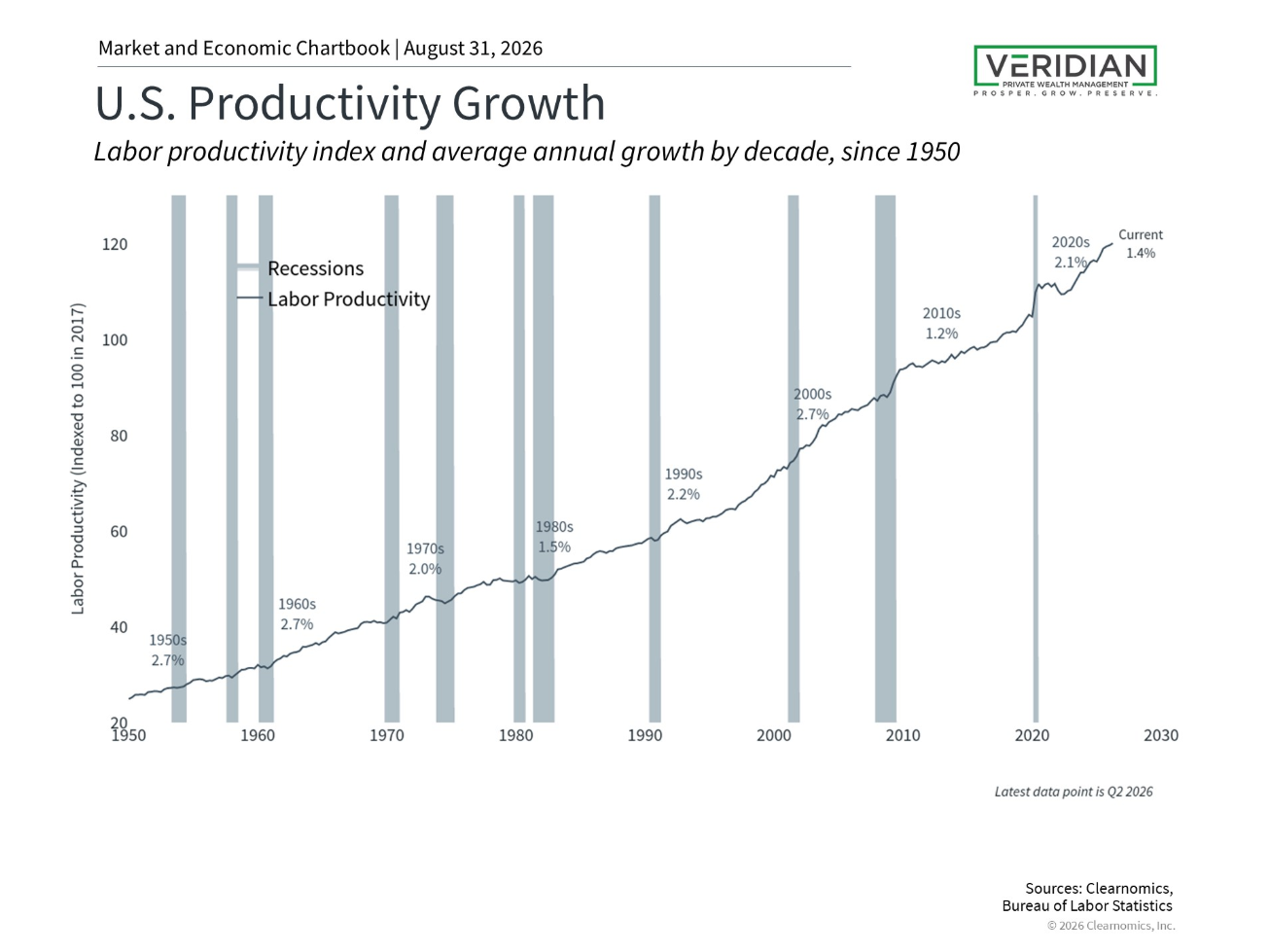
Economists typically think about growth in terms of workers and “capital,” which includes equipment and tools, but education and technology are equally important because they allow workers to produce more with the same resources. Productivity growth, though difficult to measure precisely, is what truly drives improvements in wages and living standards over time. The chart above shows that productivity growth has varied across decades but tends to rise alongside the adoption of new technologies. The expansion of the 1990s, for instance, was accompanied by an acceleration in output per worker, even though it took time to materialize.4
What makes the effect of AI both compelling and difficult to forecast is that it touches nearly all of these factors at once. AI can be viewed as labor, capital, and a means to generate even newer methods and technologies. Warsh framed this question in his speech as whether AI would be “complementary or competitive to labor.” Current evidence suggests that AI may serve more as a tool that helps workers accomplish more, much as the information technology revolution did in prior decades. As early evidence of this, some companies are now rehiring after previously reducing their workforces due to AI.3
Inflation continues to command the Fed's attention
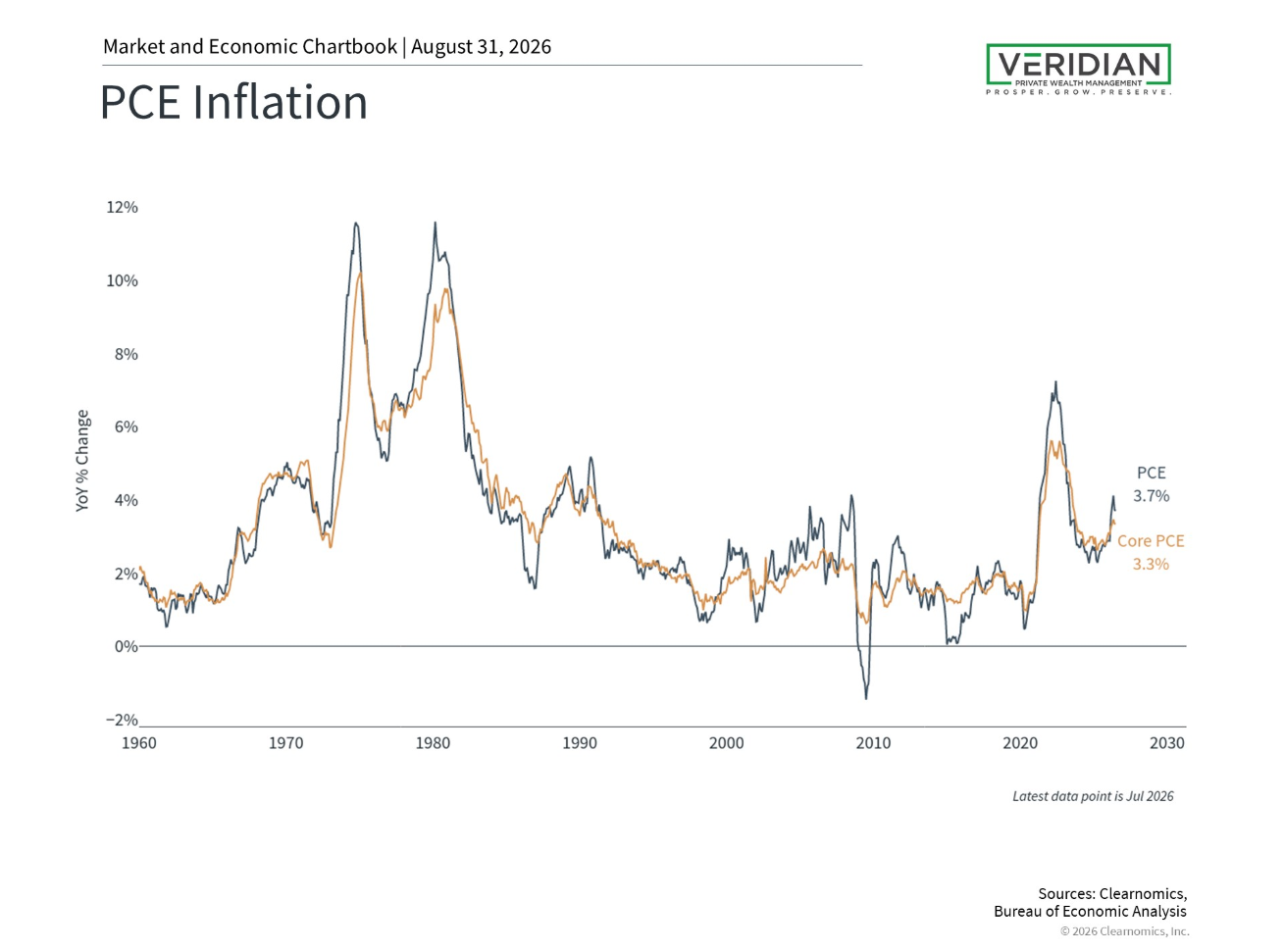
The Fed's more immediate focus remains inflation. Its preferred measure, the Personal Consumption Expenditures price index, shows that inflation rose 3.7% year-over-year, with core PCE at 3.3%.5 Both measures remain well above the Fed's 2% target, and progress over the past two years has been limited due to higher oil and gasoline prices resulting from the war in the Middle East. Markets have tried to predict when the Fed might hike rates, leading to notable swings. Current expectations point to at least one rate hike by year-end and possibly two by the end of the first quarter of next year, though these expectations can shift quickly as new data and Fed guidance emerge.
Over the longer term, however, technology tends to be naturally deflationary, since greater output and higher quality goods can put downward pressure on prices. If AI were to lift productivity meaningfully, the economy could support faster growth and higher wages with more moderate inflation. Many current inflation drivers, including oil prices, data center construction, and semiconductor shortages, have less to do with monetary policy and could fade over time. Still, that process takes time and surprises can occur, so investors are well served by not placing too much weight on any single inflation report.
The labor market remains a key indicator to watch
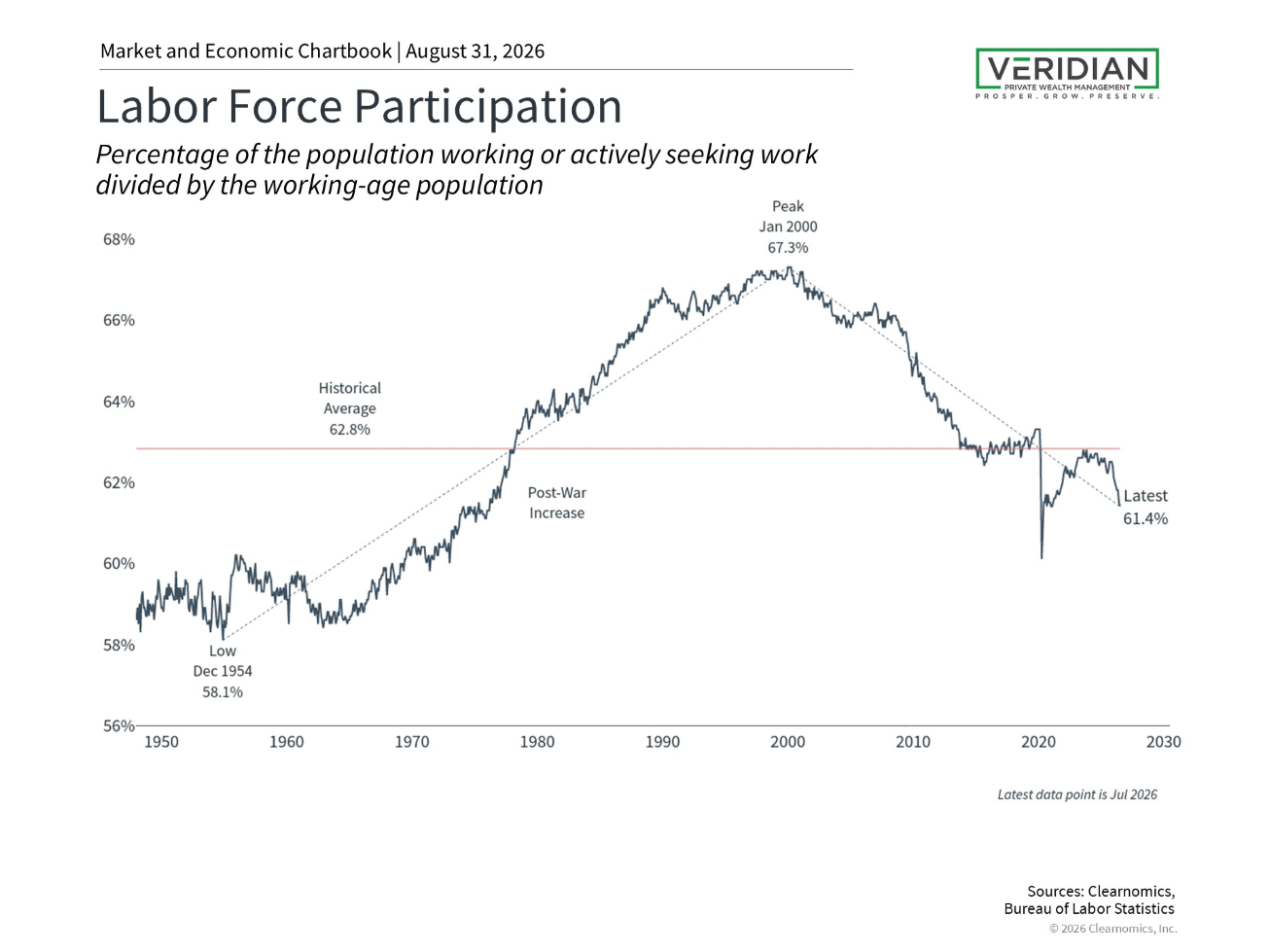
The current state of the labor market reflects a broadly healthy economy. The unemployment rate stands at a historically low 4.1% and has been stable for the past two years. Wage growth has decelerated but remains solid, at 3.1% year-over-year.6 Labor supply has grown very slowly due to aging demographics and reduced immigration, with the labor force participation rate falling to 61% in July. When labor supply is barely growing, monthly job gains can naturally be modest even as workers retain their positions and companies continue to hire as needed.
Across technology, inflation, and the job market, balancing short-term factors against long-term trends is essential for investors. Near-term market uncertainty is shaped by factors such as the conflict in Iran and the pace of data center buildouts, among others. Over years and decades, however, productivity growth and broader economic trends are what will drive financial markets. Maintaining focus on long-term goals remains the most reliable path toward financial success.
The bottom line? The Fed faces a difficult balance between inflation and the job market, especially as AI trends continue to develop. For investors, it's best to maintain a long-term perspective aligned with financial goals.

Angela Major Hart, J.D., CFP®
Angela Major Hart, J.D., CFP® has extensive work experience in the financial and legal sectors and has an unparalleled passion for delivering top-tier client service, portfolio management, and wealth planning.

224-760-4416
Contact